KARMA, NATURAL DISASTERS AND CLIMATE CHANGE: A BUDDHIST PERSPECTIVE
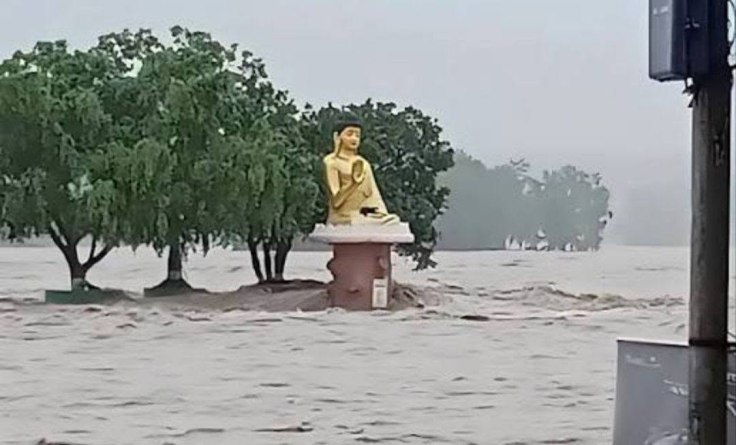
In recent days, there has been considerable discussion about the role of karma in relation to the tragic events that have occurred in Nepal and the Tibet Autonomous Region, particularly in connection with the devastating flooding caused by the overflow of the Bhotekoshi River in Nepal. Without getting drawn into the somewhat fanciful political and ideological interpretations of these tragic events circulating on social media, it is worth making a few clarifications from the perspective of Buddhadharma.
First, according to the Dharma traditions, the fruits of karma (vipāka) are not punishments, but the consequences of intentional actions. Dying in a natural disaster is not a divine punishment, as it might be understood within the Abrahamic religions. The teaching on karma is not intended to foster guilt, but rather to encourage a sense of individual and collective responsibility.
Second, “one’s own karma” has nothing to do with the physical processes that give rise to extreme natural events such as earthquakes and floods. The natural law governing such phenomena is referred to in Pāli as utu-niyāma.
Third, not everything that happens in an individual’s life is determined by intentional actions. According to the Sīvaka Sutta of the Saṃyutta Nikāya, there are at least seven factors involved, which Buddhaghosa, in the Atthasālinī, condenses into five:
1.Physical and environmental order (utu-niyāma);
2.Biological order (bīja-niyāma);
3.Psychological order (citta-niyāma);
4.Natural order of phenomena (dhamma-niyāma);
5.Karmic order (kamma-niyāma).
Our circumstances are shaped by a complex and ultimately unfathomable interplay of these different orders.
Finally, not all actions are operative or necessarily produce results, as the Buddha explains in the Mahākammavibhaṅga Sutta:
“Ānanda, there are actions that are ineffective and appear ineffective; there are actions that are ineffective but appear effective; there are actions that are effective and appear effective; and there are actions that are effective but appear ineffective.”
HUMAN ACTIVITIES AND CLIMATE CHANGE
We have said that the destiny of the individual is shaped by the complex and inextricable interaction of the five natural orders mentioned above. What allows the universe to function harmoniously is the law of interdependence—the heart of Buddhist teaching—according to which phenomena exist only in mutual relationship. That human activities have an effect on the natural environment is by now well established. But correlation and causation are not the same thing. Establishing a direct causal relationship between human activity in general and a specific event, such as the melting of a glacier, would, in my view, be far-fetched in the absence of substantial evidence.
Personally, I see too great a logical leap in this argument: we move from physical causation to a supposed karmic correlation. Moreover, an important clarification is needed to avoid misunderstanding: karma is a technical term with a specific meaning. It does not simply mean “action” or “activity,” but intentional action rooted in cetanā, that is, volition.
As for the nature of karma, the various schools of Indian Buddhism debated the issue for centuries without reaching a definitive conclusion. It is enough to consider the disagreements between the Theravāda and the Andhakas recorded in the Kathāvatthu (The Book of Controversies) of the Abhidhamma[1]. The Buddha himself described karma as acinteyyaṃ—something that cannot be fully comprehended by the human mind.
In the specific case under discussion, the flooding that devastated the border region between Nepal and the Tibet Autonomous Region appears to have been linked to the melting of a glacier. Alternatively, hypotheses involving seismic activity have also been put forward, which would not be unusual in such a seismically active region.
Furthermore, climate change and natural disasters existed long before the advent of Homo sapiens, the Industrial Revolution and the globalisation. Obviously, becoming involved in a natural disaster can also have something to do with personal and collective choices. If, for example, I decide to go on vacation in an earthquake-prone area, I may end up being caught in an extreme event. This, however, has nothing to do with divine punishment for supposed sins—which are sins only within a moral framework that regards them as such.
On the other hand, if a couple decides to live in an earthquake-prone area, despite having the possibility of making different choices, what responsibility could their newborn child possibly bear for the harmful consequences of that shortsighted choice? And what about people who are forced to live in such places, with no possibility of exercising any meaningful choice over their living conditions? And what, then, are we to say about animals, who have no conceptual understanding of the law of karma, yet simply live according to the rhythms of nature?
Incidentally, the idea of rebirth, as understood in Eastern religious traditions, is also relevant to addressing objections of this kind. One possible explanation would be that if something bad happens to an innocent person in this life, it must be the result of something they did in a previous life, of which they have no memory. Yet the Buddha seems to have adopted a more nuanced and pragmatic approach, as evidenced by the two suttas cited above, an approach that was also taken up by later commentators such as Buddhaghosa.
On the other hand, if someone decides to build a house on the bank of a river and the river subsequently floods, sweeping away that person and their loved ones, then it is reasonable to speak of a connection between the decision to act in a certain way and its consequences over time. Again, there is no need to invoke either guilt or divine punishment.
ON SHARED KARMA
In Buddhist circles, we often hear the term “collective karma” used rather loosely, without precise references to the scriptural sources on which the concept is based. As we said earlier, Karma means “action,” but in the specific context of the Buddha’s teachings, the term refers to intentional action (cetanā), which may be wholesome, unwholesome, or neutral. It can also be classified into two types according to its temporal function: old karma (purāṇa) and new karma (nava). Old karma refers to actions performed in the past whose effects are experienced in the present; new karma, on the other hand, refers to actions performed in the present whose effects will be experienced in the future.
It is therefore important to clarify that, when we speak of “collective karma,” we are actually referring to shared karmic results (vipāka), rather than to karma itself. This ambiguous use of the term “karma”—which has caused, and continues to cause, considerable confusion—was already found in the Buddha’s time, and perhaps even earlier.
According to the Theravāda tradition, there is no such thing as “collective karma,” since karma is, by definition, rooted in individual intention and choice. However, the commentary on verse 127 of the Dhammapada appears to suggest a somewhat different possibility[2]. Although, for the reasons outlined above, speaking of “collective karma” may sound like a contradiction in terms, it may be more accurate to speak of “shared karma”: a similar experience undergone by multiple people as a result of shared choices and circumstances.
In the Sarvāstivāda tradition, particularly in the commentaries associated with Vasubandhu, we also find the idea of shared karma—that is, karma arising from a choice or decision made collectively by a group of people. In the Abhidharmakośabhāṣya, a text associated with the Sarvāstivāda tradition, Vasubandhu writes:
“When many people unite with the intention of killing, whether in war, hunting, or banditry, who is guilty of murder if only one of them kills? Since soldiers and others conspire to bring about the same result, all are guilty just as the one who kills. Having a common goal, all are guilty just as the one who kills among them, because they incite one another, not through words, but simply by being united in the intention to kill. But is someone who has been forcibly compelled to join the army also guilty? Evidently yes, unless he has made the decision: ‘Not even to save my life will I kill a living being.’”
For these reasons, Buddhist ethics is not limited to promoting the well-being of the individual, but also takes into consideration the well-being of society as a whole, as expressed clearly in the words of Ven. Vajirarama Piyadassi:
“The precepts on the right way of life were designed to foster genuine happiness for the individual and society, and to promote harmonious relations among people.”
Unfortunately, the consequences of other people’s choices can also fall upon those who had nothing to do with those choices. But this, in turn, is an extraordinarily complex issue.
NOTES
1. Cf. Ven. Buddhaghosa’s remarks in his commentary on the Kathāvatthu: “Because some actions lead to the deterioration called ‘aging’ and the shortening of life called ‘death,’ some, like the Andhakas, are of the opinion that aging and death are the result (vipāka) of such actions. Now, there exists, between morally negative action and material decay, that relationship known as karma, but the moral cause and the material effect are of different kinds. Therefore, the latter (the effect) is not a subjective result (vipāka). It differs from every other mental state—contact, sensation, etc.—as products of [past] karma. Furthermore, it is partly due to the environmental and seasonal factor (utu-niyāma).”
2. Although the Theravāda tradition does not accept the idea of a ‘shared karma,’ the Pāli Canon contains several examples of what might be described as ‘partially shared karma.’ Take, for instance, the tragic fate of the Sakya clan, whose members were largely massacred by the troops of General Viḍūḍabha following the deception suffered by his father—to whom the Sakyas had sent a slave girl disguised as a princess—as narrated in the commentary on verse 127 of the Dhammapada.
Davide Puglisi
Dhammadāna Buddhist Group – Italy


Rispondi